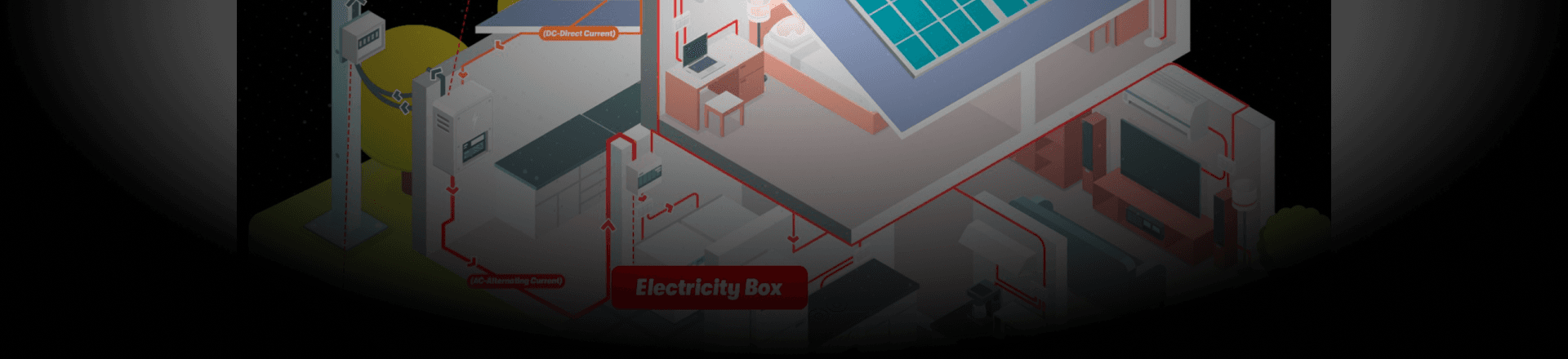
For more than a century, electricity grids were designed for one-directional power flows: large centralized power plants generating electricity and consumers passively receiving it. Today, that model no longer reflects reality. Modern power systems must manage bi-directional flows, integrate intermittent generation from large-scale wind and solar plants, and connect millions of distributed solar producers from rooftops, farms, commercial buildings, and industrial sites.
In this new energy architecture, the grid is no longer just infrastructure — it has become both the limiting factor and the enabling foundation for the deep development of solar and renewable energy systems.
Rising Demand and the Structural Pressure on Grids
Global electricity demand is rising steadily, driven by electrification of transport, heating, industry, data centers, and digital infrastructure. This rising demand is accelerating the transformation of power systems, forcing grids to evolve from static transmission networks into flexible, digital, and resilient energy platforms capable of balancing variable generation and decentralized consumption.
Solar power — especially distributed solar — changes grid dynamics fundamentally. Instead of predictable, centralized injection points, electricity now enters the system from thousands of nodes: residential rooftops, commercial installations, agricultural systems, and renewable energy projects embedded deep within local distribution networks. This shift increases the need for:
- grid reinforcement and expansion
- digital monitoring and control systems
- flexibility resources and storage integration
- cross-border and interregional transmission capacity
- smarter distribution grids for local balancing
Without sustained grid investment, solar growth becomes structurally constrained — regardless of module efficiency improvements or falling generation costs.
Global Grid Investment: A Clear Acceleration Trend
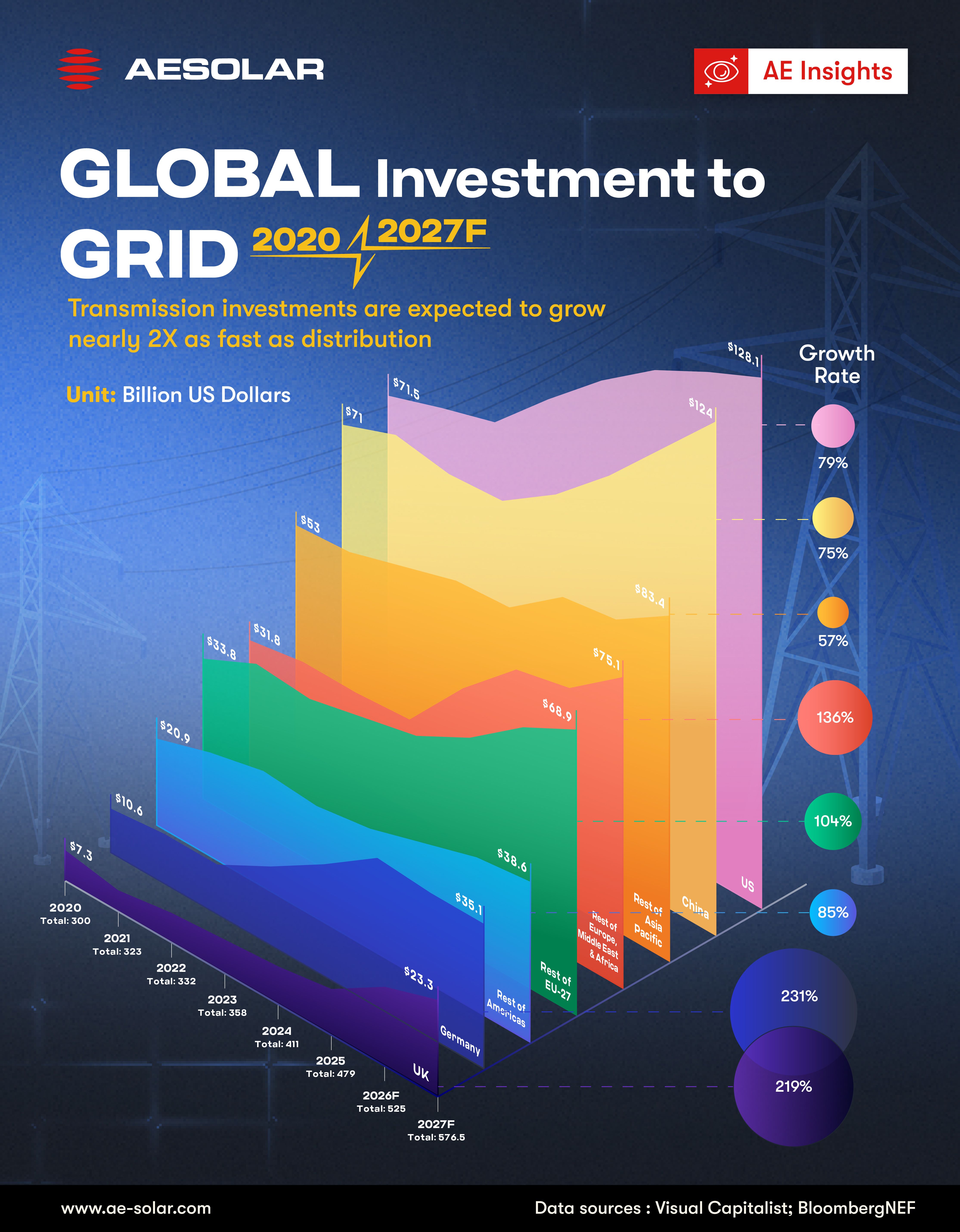
The latest data shows a decisive acceleration in global grid investment between 2020 and 2027F. Total global investment rises from USD 300 billion in 2020 to a projected USD 576.5 billion by 2027, with a particularly sharp increase after 2023. By 2025 alone, global grid investment is projected to reach USD 479 billion, reflecting a structural shift rather than a cyclical fluctuation.
Key regional dynamics highlight how different markets are responding to the same systemic pressure:
- United States: Growth from USD 71.5 bn (2020) to USD 128.1 bn (2027F), +79%
- China: Growth from USD 71 bn to USD 124 bn, +75%
- Germany: Growth from USD 10.6 bn to USD 35.1 bn, +231%
- UK: Growth from USD 7.3 bn to USD 23.3 bn, +219%
- EU-27 (excl. Germany & UK): Growth from USD 33.8 bn to USD 68.9 bn, +104%
Germany’s trajectory is particularly notable. As a country with high renewable penetration, strong distributed solar deployment, and advanced energy policy frameworks, Germany illustrates how grid investment becomes a strategic enabler for renewable scaling rather than a reactive upgrade measure.
Transmission investments are expected to grow nearly twice as fast as distribution, reflecting the parallel need for long-distance renewable transport and local grid intelligence.
Grid Investment as a Prerequisite for Renewable Integration
Solar and renewable energy projects do not fail because of generation technology limitations — they fail when grid capacity, flexibility, and stability lag behind deployment speed. Modern grid investment supports:
- Integration of utility-scale solar and wind
- Grid access for distributed solar producers
- System stability under intermittency
- Electrification of transport and heating
- Digital coordination of millions of assets
- Resilience against climate-driven disruptions
As highlighted by organizations such as BloombergNEF and International Renewable Energy Agency, grid infrastructure is now recognized as the core bottleneck of the global energy transition — not generation capacity itself.
This strategic shift is increasingly visible at the global policy level. At COP30, utilities and governments have announced long-term grid investment plans approaching USD 1 trillion, acknowledging that without strong grids, climate targets, decarbonisation strategies, and renewable integration pathways remain structurally fragile.
From Infrastructure to Energy Platform
The grid is evolving from passive infrastructure into an active energy platform — enabling flexibility markets, distributed energy resources, storage integration, hydrogen pathways, and local energy ecosystems. For solar, this transformation is decisive:
- Solar becomes a system resource, not just generation capacity
- Distributed solar becomes a grid asset, not a grid burden
- Renewable energy projects become nodes in intelligent networks
- Storage, flexibility, and digital control become as important as modules
In this context, grid investment is not an auxiliary policy tool — it is the structural backbone of the future electricity system.
Conclusion
As global grid investment accelerates toward record levels ahead of COP30, one conclusion is increasingly clear: the future of solar and renewable energy will be shaped not only by generation capacity, but by how effectively electricity systems can integrate distributed solar, manage intermittency, and respond to rising demand. Grids are becoming the decisive enabler that determines whether renewable energy projects scale smoothly or face structural bottlenecks.
In this evolving landscape, solar manufacturers must think beyond modules alone. System compatibility, grid adaptability, and long-term reliability are now central to project success — particularly in advanced markets such as Germany and across Europe, where renewable penetration and grid complexity are already high.
Founded in Germany in 2003, AESOLAR develops photovoltaic solutions with this system perspective in mind. Its portfolio spans utility-scale, commercial and industrial, residential, and niche applications such as agrivoltaics, carports(with DIBt certification), urban solar, and cold-climate installations, supporting both centralized and distributed solar deployment. By combining advanced module design with durability, certification, and long-term bankability, AESOLAR solutions are engineered to perform reliably within increasingly sophisticated grid environments.
As grid investment reshapes the global energy system, the convergence of robust infrastructure and high-quality solar technology will define the next stage of the energy transition. In that context, solar is no longer a standalone technology — it is part of an integrated electricity ecosystem where grid readiness and product reliability advance together.