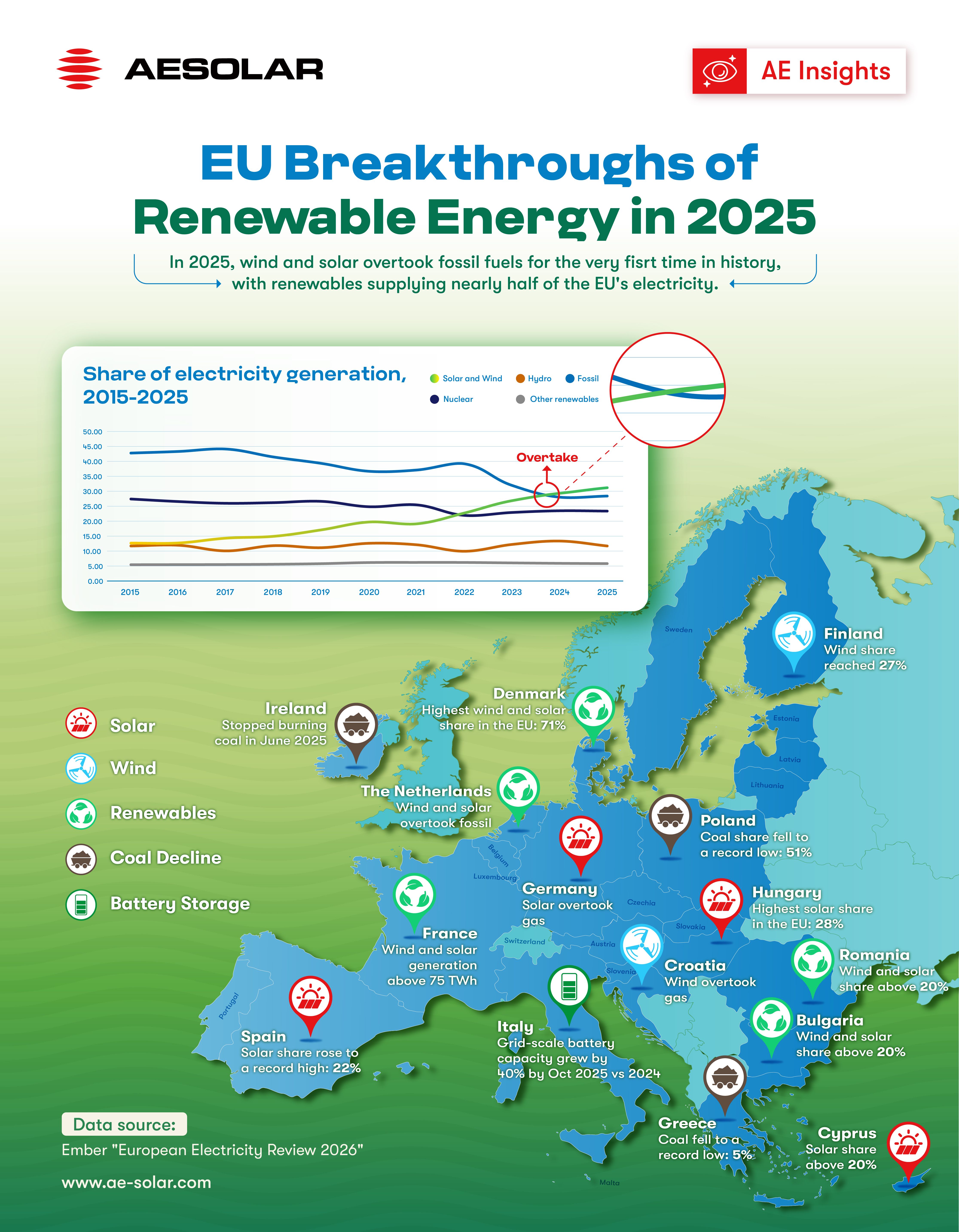
According to the latest European Electricity Review 2026 published by Ember, the year 2025 marked a historic milestone for the European power sector. For the first time ever, wind and solar generation together overtook fossil fuels in the European Union’s electricity mix, signaling a structural shift in how the continent produces and consumes energy.
The data shows that non-fossil energy supplied 70% of the EU’s electricity in 2025, with wind and solar playing an increasingly dominant role. This milestone highlights the acceleration of Europe’s clean energy transition and reflects years of policy support, technological innovation, and rapidly expanding renewable deployment across member states.
A Historic Turning Point for the EU Power System
For decades, Europe’s electricity generation was dominated by fossil fuels such as coal and gas. However, the rapid expansion of renewable capacity—combined with falling technology costs and stronger climate policies—has steadily reshaped the generation mix.
In 2025, wind and solar collectively surpassed fossil fuel generation, while renewables supplied nearly half of the EU’s total electricity demand. Solar energy continued to be one of the fastest-growing sources of power in Europe, benefiting from large-scale deployment across utility projects, commercial installations, and distributed rooftop systems.
This milestone reflects not only technological progress but also the long-term policy direction set by the EU’s climate targets and energy security strategy.
National Records Across Europe
The transition is visible across many European countries. Several member states recorded historic achievements in renewable electricity generation in 2025.
Denmark maintained its position as a renewable leader, with wind and solar together accounting for around 71% of electricity generation. In Germany and the Netherlands, wind and solar generation overtook fossil fuel generation for the first time, marking a significant milestone for Europe’s largest energy markets.
Southern European countries also demonstrated strong solar growth. Spain reached a record solar share of around 22%, while Cyprus saw solar generation exceed 20% of electricity supply. Meanwhile, Poland recorded a historic low share of coal generation, highlighting the region’s accelerating transition away from fossil fuels.
Across Europe, these national records illustrate how renewable energy is moving from a supplementary role toward becoming the backbone of the electricity system.
Batteries Begin to Support Renewable Integration
Another important development highlighted in the report is the early impact of battery storage in stabilizing renewable electricity systems. As wind and solar penetration rises, energy storage is becoming an increasingly critical component of grid flexibility.
Battery deployment is expanding rapidly across Europe, helping to absorb excess renewable generation during periods of high production and releasing it when demand rises. While still in the early stages, the growth of storage technologies indicates that Europe’s power system is gradually evolving to accommodate higher shares of variable renewable energy.
Solar’s Expanding Role in the Energy Transition
Solar power continues to be one of the most scalable solutions within the EU’s clean energy transition. Rapid installation growth, declining technology costs, and strong policy support have enabled solar to expand across multiple application scenarios—from large-scale solar parks to commercial rooftops and urban energy solutions.
Equally important is the diversification of solar applications. New installation models such as solar carports, vertical PV systems, agrivoltaics, and urban solar integration are opening additional opportunities for clean electricity generation without competing for land or infrastructure. For European manufacturers and technology providers, this transformation highlights the importance of innovation, quality, and specialized solutions designed for diverse environments.
Looking Ahead
Europe’s energy transition is accelerating. Wind and solar power have moved beyond niche technologies and are now central pillars of the EU electricity system. Continued investment in grids, storage, and advanced solar solutions will be essential to sustain this momentum. As the deployment of solar power expands across new sectors and applications, AESOLAR continue to support the global transition with innovative photovoltaic solutions designed for a wide range of environments—from traditional power plants to emerging niche markets.
The breakthrough achieved in 2025 is not the end of the journey, but a powerful indication that the renewable energy era in Europe has firmly begun.