Germany’s energy transition is often measured in gigawatts of renewable capacity. Yet another shift is taking place inside the home: households are using electricity more carefully, while digital devices account for a growing share of demand.
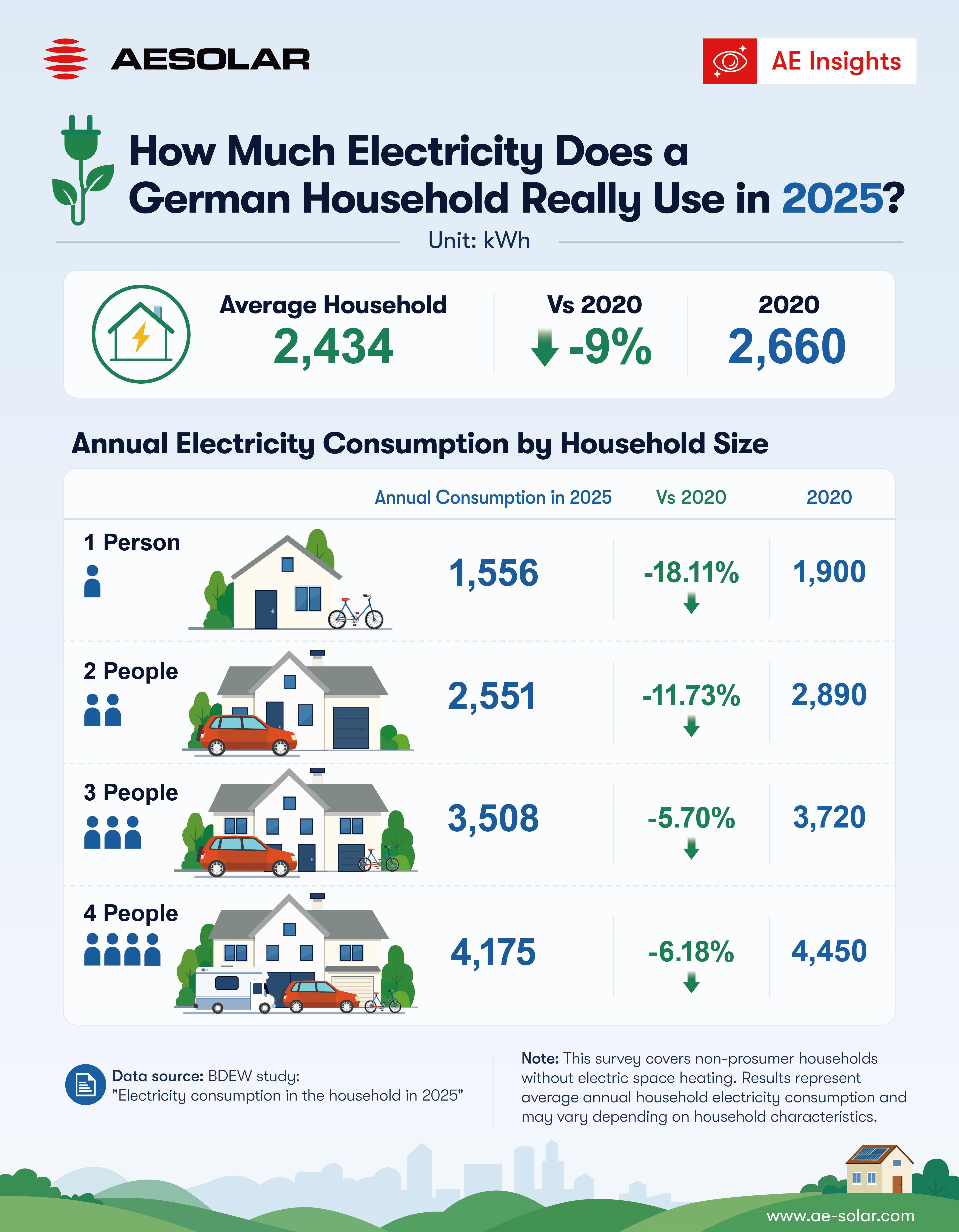
According to the latest BDEW study on household electricity consumption, an average German household used 2,434 kWh of electricity in 2025, compared with 2,660 kWh in the 2019/20 reference period. That is a reduction of around 230 kWh, or nearly 9%.
Consumption is falling across household sizes
The decline appears in every household group, although its scale differs:
- A one-person household used an average of 1,556 kWh, down from 1,900 kWh.
- A two-person household used 2,551 kWh, compared with 2,890 kWh.
- A three-person household used 3,508 kWh, down from 3,720 kWh.
- A household with four or more people used 4,175 kWh, compared with 4,450 kWh.
The largest relative reduction came from one-person households at about 18%, followed by almost 12% for two-person households. The reductions for larger households were more moderate. This suggests that efficiency and more conscious electricity use are becoming visible even in smaller homes, where fixed loads cannot be shared across several people.
Averages are benchmarks rather than personal targets. Household size, building type, electric water heating, appliance use and working patterns can all change the result, as an independent review of the BDEW study also emphasises.
A more digital home uses electricity differently
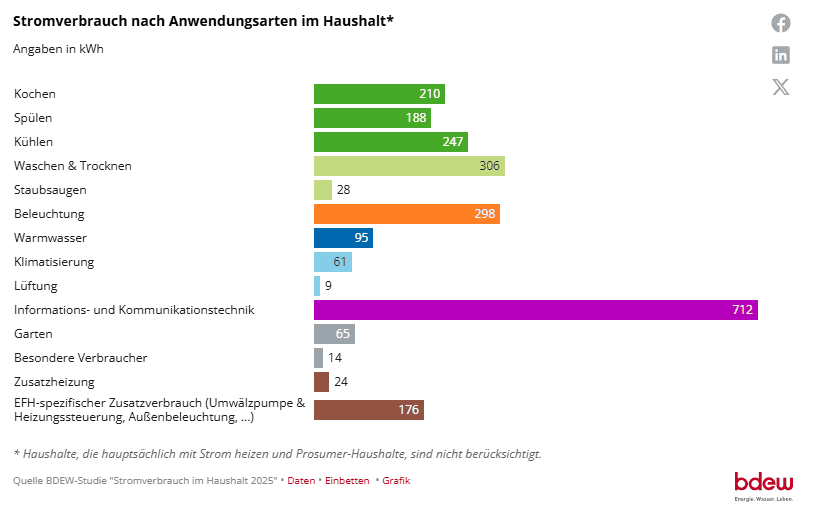
Lower total consumption does not mean every category is shrinking equally. Information and communication technology, including televisions, computers, routers and smartphones, accounted for 712 kWh, or 29.2%, of average household use in 2025. Its share rose from 27.3% in 2020, making it the largest category in the BDEW analysis.
Home-office households also recorded somewhat higher consumption, although BDEW cautions that working from home is not necessarily the only cause. The energy question is therefore no longer only how much electricity is used, but also when it is needed, where it comes from and how intelligently it can be managed.
What the figures do and do not tell us about solar
The headline analysis covers 7,503 non-prosumer households. It excludes homes with photovoltaic systems and homes in which EVs are charged; the averages also exclude electric space heating and use defined water-heating configurations. The figures should therefore not be interpreted as evidence that rooftop solar caused the decline.
However, a separate survey of 1,007 prosumer households reveals another positive development. 11.8% of prosumers already used a dynamic electricity tariff, compared with 1.9% of non-prosumers. Among prosumers not yet using one, 69.7% could imagine shifting washing-machine use to lower-price periods, 60.7% dishwasher use, 47.2% EV charging and 29.1% battery charging.
These findings point towards the next stage of residential solar. When photovoltaic generation, storage and flexible demand work as one system, households can use more solar electricity directly, store surplus production and schedule loads around solar availability or market signals.
From lower consumption to smarter consumption
Germany’s falling household electricity use is encouraging, but the bigger story is the move from passive consumption to active energy management. Efficiency reduces demand, solar brings clean generation closer to the user, and storage connects supply and demand across the day.
The practical path is clear: understand the consumption profile, improve efficiency and design solar-plus-storage around real demand. For the renewable energy industry, future value will come not only from generating more clean electricity, but from helping every kilowatt-hour work harder.
At AESOLAR, we see this as a positive sign. A more informed, efficient and flexible household is better prepared for a decentralised, solar-powered energy future.
Data note: The survey data were collected from mid-September to early December 2025 and published by BDEW in May 2026. The detailed methodology and figures are available in the BDEW study.