AIDC clean energy solutions are moving from sustainability plans to infrastructure priorities. Artificial intelligence is changing not only the digital economy, but also the electricity system behind it.
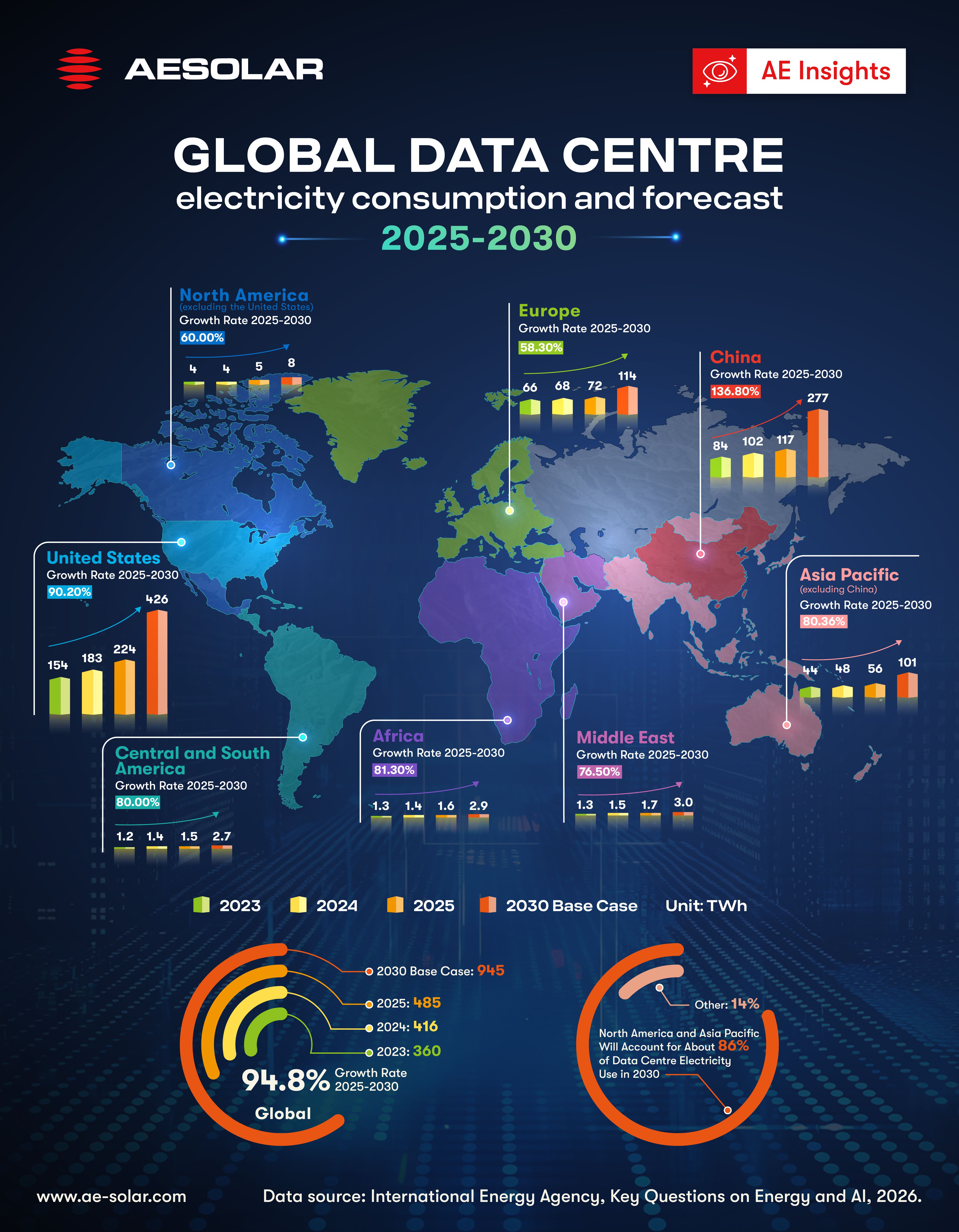
Global data-centre electricity consumption reached approximately 485 TWh in 2025 and is projected to approach 950 TWh by 2030. Electricity use from AI-focused data centres alone grew by 50% in 2025, while the power density of AI servers increased elevenfold between 2020 and 2025, according to the IEA.
The question is: where will the additional electricity come from?
This cannot be one technology. Reliable AI data-centre infrastructure requires a layered energy architecture combining the grid, renewable electricity contracts, on-site generation, energy storage and dedicated critical backup. Within that system, solar PV offers something increasingly valuable: the ability to add clean electricity close to where demand is growing.
AI growth is becoming an electricity challenge
Europe's data-centre market is expected to reach 13 GW by the end of 2026, representing 20% growth from 2025. New European colocation capacity contracted specifically for AI applications more than quadrupled during the first half of 2026. Electricity demand is rising with capacity. The IEA expects European data-centre electricity use to increase by more than 45 TWh between 2024 and 2030, a rise of approximately 70%.
Yet building new computing capacity can be faster than expanding the power system. Across eight EU countries with available data, almost 700 GW of renewable energy projects are waiting in grid-connection queues. Ember also identifies a potential 120 GW gap between planned renewable deployment and available grid capacity by 2030 across 20 reporting countries.
Southeast Asia faces a different version of the same challenge. Malaysia's data-centre electricity demand could grow from approximately 9 TWh in 2024 to 68 TWh in 2030, potentially reaching around 30% of national electricity consumption. Indonesia, Thailand, Vietnam and the Philippines are also attracting major digital-infrastructure projects, frequently in industrial corridors where power availability, transmission capacity and carbon intensity already influence investment decisions.
The AI race is therefore becoming an energy race. Regions that can connect new capacity to reliable and lower-carbon electricity will be better positioned to attract long-term digital investment.
AIDC clean energy solutions start with solar PV
Solar cannot power a large AI data centre around the clock by itself. Data centres operate continuously, while solar production changes with weather and time of day. However, this does not reduce the value of solar. It clarifies its role.
This approach is already influencing data-centre development. In Singapore, four projects awarded a combined 200 MW of capacity under the second Data Centre Call for Application must present pathways to power at least 50% of their proposed facilities with green energy.
In land-constrained markets, every suitable surface matters. In industrial markets with more available land, larger rooftop, carport and ground-mounted projects can make a greater contribution. AESOLAR PV modules can support this generation layer across a range of site conditions, helping developers increase local clean-energy production and reduce, rather than eliminate, dependence on the grid.
That distinction matters. The credible goal is not an off-grid AI campus. It is an AI campus with more local generation, a cleaner supply mix and greater control over part of its energy demand.
Energy storage completes the campus architecture
Solar production is concentrated during daylight hours, while data-centre demand continues through the night. Energy storage helps connect these two profiles.
The IEA estimates that approximately 20 to 25 GW of battery capacity could be installed inside data centres globally by 2030. In Malaysia, the planned Southern Johor Renewable Energy Corridor provides a practical example of the scale emerging around digital and industrial demand. Its initial phase is designed to include up to 4 GWp of solar capacity and 5.12 GWh of battery storage, with data centres and multinational manufacturers among the intended customers.
This is the complete logic of solar and storage for AIDC:
1.PV modules generate additional clean electricity.
2.Campus-scale batteries shift and manage part of that electricity.
3.The grid and renewable PPAs or DPPAs provide continuous supply at scale.
4.Dedicated UPS and backup systems protect critical computing loads.
These layers are complementary, not interchangeable. AESOLAR's role is centred on solar modules and its growing residential and light-commercial storage portfolio (AESOLAR). Larger C&I and utility-scale storage can be discussed as part of the wider project architecture delivered through specialist technology and energy partners.
Building a cleaner energy foundation
AI will require more computing capacity and significantly more electricity. It is to build digital growth and clean energy at the same time.
Solar PV provides the generation foundation. Campus-scale and utility-scale storage add flexibility. The grid, PPAs and DPPAs provide continuity and scale. Dedicated backup systems protect critical loads. Residential and light-commercial ESS extend the benefits of distributed energy to the communities around new digital infrastructure.
AESOLAR supports this transition through PV modules designed for diverse project environments and a growing portfolio of residential and light-commercial energy-storage solutions. Together, these technologies can help customers increase local clean-energy generation, reduce part of their grid dependence and participate in a more resilient energy ecosystem.
AESOLAR's Solar and Storage Portfolio
AESOLAR's product portfolio maps directly onto that layered architecture.
Horizon carport modules (420–590W) turn parking structures and canopies into DIBt-certified overhead generation — Germany's structural approval for PV installed above people and vehicles — making them well suited to campus, staff, and EV-charging parking areas.
Meteor rooftop modules (415–730W), AESOLAR's core N-type TOPCon line, span utility-scale, C&I, and residential rooftop deployment across a wide range of configurations.
Eclipse back-contact modules (470–660W) push efficiency higher for sites where roof or ground space is limited.
Alpine modules (430–510W) add Swiss VKF HW4-certified hail resistance (TÜV Rheinland-verified) for coastal, mountainous, or hail-prone locations.
Together, these product lines give AIDC developers and site planners several concrete ways — rooftop, carport, hail-resistant ground-mount, and storage — to add local clean-energy generation exactly where demand is growing.
Contact AESOLAR to explore solar PV and distributed energy-storage solutions for your next clean-energy project in Europe or Southeast Asia.