
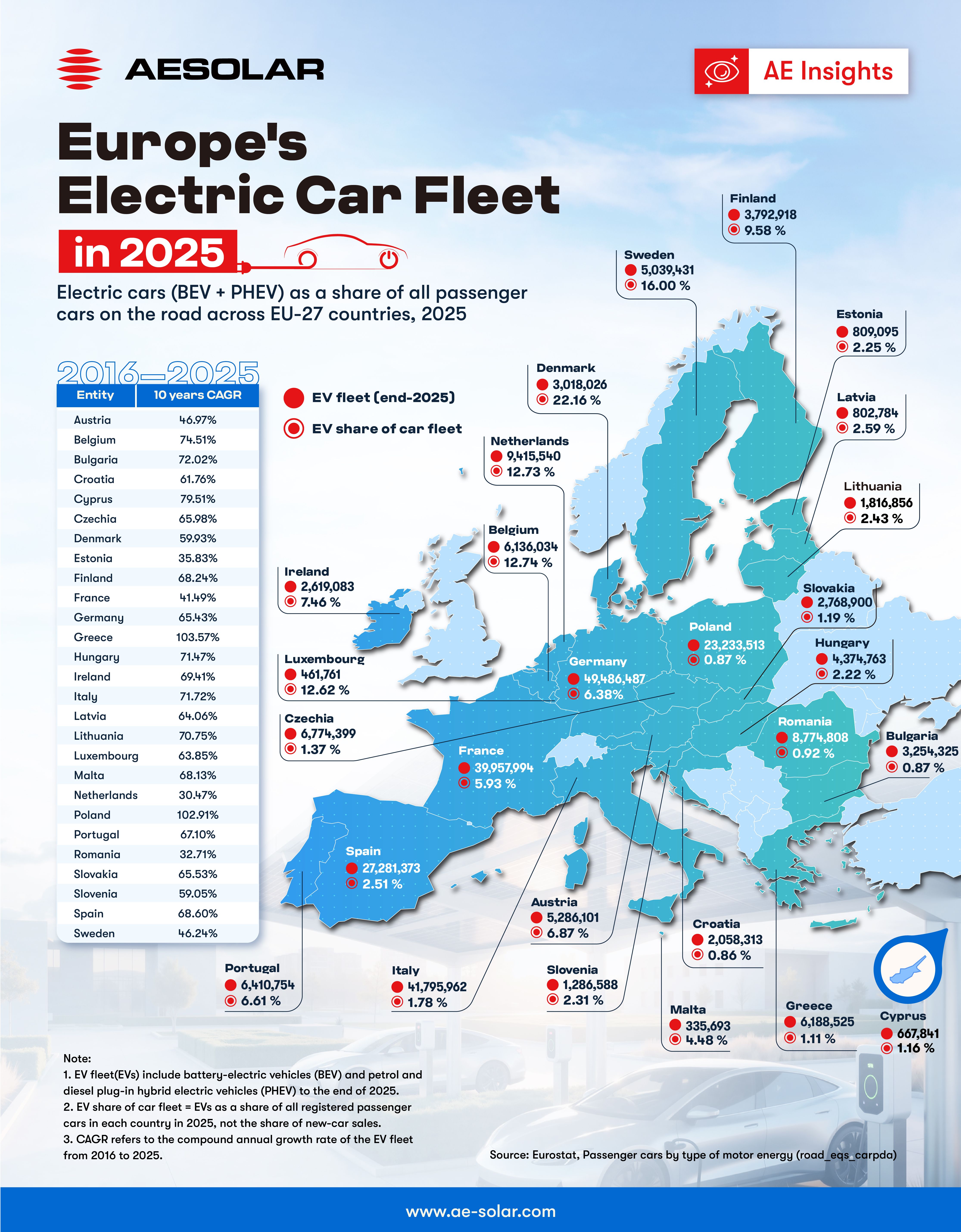
By the end of 2025, roughly 12.6 million electric cars, battery-electric (BEV) and plug-in hybrid (PHEV) combined, were registered across the EU-27. That sounds like a lot until you set it against the 264 million passenger cars on Europe's roads. Electric cars made up about 4.8% of the fleet, or roughly one in every twenty cars The more interesting story is how unevenly that one in twenty is spread.
A Map of Two Speeds
In Denmark, more than one car in five on the road is now electric (22.2%). Sweden follows at 16.0%, with Belgium, the Netherlands and Luxembourg all at around 12.7%. At the other end of the map, Poland, Bulgaria, Croatia and Romania are still below 1%. Sixteen of the 27 member states have an EV share under 5%.
Size matters too. Germany (6.4%) and France (5.9%) have only middling shares, but because their car fleets are so large, they account for more than 40% of all electric cars in the EU.
But, over 2016–2025, the EV fleet grew by more than 60% a year in most member states. Greece and Poland roughly doubled their fleets every year, although from a very low base. The Netherlands, an early adopter, grew more slowly at 30% a year, a sign of a market that has moved past its first wave.
A Decade Shaped by Policy
These numbers did not appear by accident. In 2016, carmakers were working towards the EU's fleet-wide target of 95 g CO₂/km for new cars, phased in from 2020 under Regulation (EC) No 443/2009. That deadline helps explain why so many electric models reached showrooms around 2020.
The framework then tightened. Regulation (EU) 2023/851 introduced a 100% CO₂ reduction target for new cars from 2035. Under current law, that means an EU fleet-wide target of 49.5 g/km from 2030 and zero from 2035. But, the direction is now being debated. In 2025, manufacturers were allowed to meet their 2025–2027 targets as a three-year average under Regulation (EU) 2025/1214. In December 2025, the Commission proposed lowering the 2035 target to a 90% reduction, leaving room for plug-in hybrids and other powertrains. The European Parliament's plenary vote is expected on 23 November 2026, and no final agreement has been reached.
Demand, meanwhile, keeps moving. Battery-electric cars took 22.7% of new EU car sales in the first nine months of 2026, up from 16.1% a year earlier, with plug-in hybrids adding another 10.1%. Germany has also reintroduced purchase support: a grant of up to €6,000 for private buyers of eligible electric cars registered from 1 January 2026.
The Question Behind the Numbers
A fleet changes slowly. Even with roughly a third of new cars now plug-in, it will take years for the share of electric cars on the road to catch up. Each of those cars still needs a place to charge.
EU rules increasingly point to where cars already park. The Alternative Fuels Infrastructure Regulation requires public charging capacity to grow in line with the fleet, with at least 1.3 kW of public charging power for each registered battery-electric car.
The recast Energy Performance of Buildings Directive goes further into car parks:
- By 1 January 2027, non-residential buildings with more than 20 parking spaces must have at least one recharging point for every ten spaces, or ducting for at least half of them.
- By the end of 2029, suitable solar installations are required on all new roofed car parks physically adjacent to buildings.
Put these together and the car park starts to look different. It is where vehicles spend most of their time, where charging demand is growing, and where a roof can generate electricity during the same daylight hours that many cars stand idle. In countries where EV shares are already in double digits, this is a practical question about capacity and grid connections. In markets still below 1%, it is a chance to plan the parking space and the power supply together from the start.
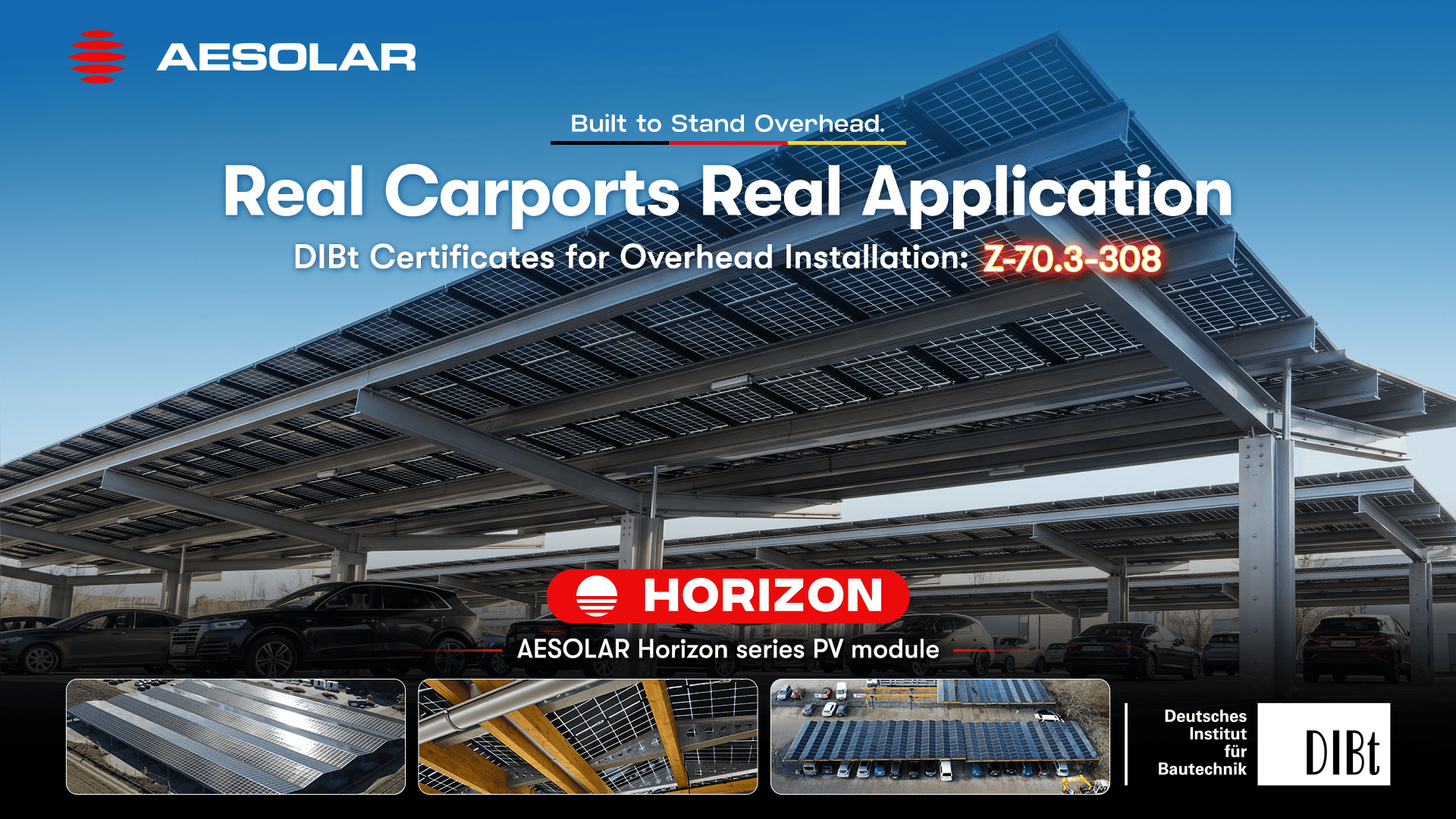
Europe's electric car fleet has grown quickly, but it is still at an early stage and unevenly spread. Policy may be adjusting the pace, but not the direction. As more cars plug in, the parking space is becoming part of the energy system, and solar carports are one of the most natural ways to make it work.
Explore AESOLAR Horizon solar carport solutions