AI may feel weightless, but every model, search and generated image runs through servers, cooling systems and electricity networks working around the clock.
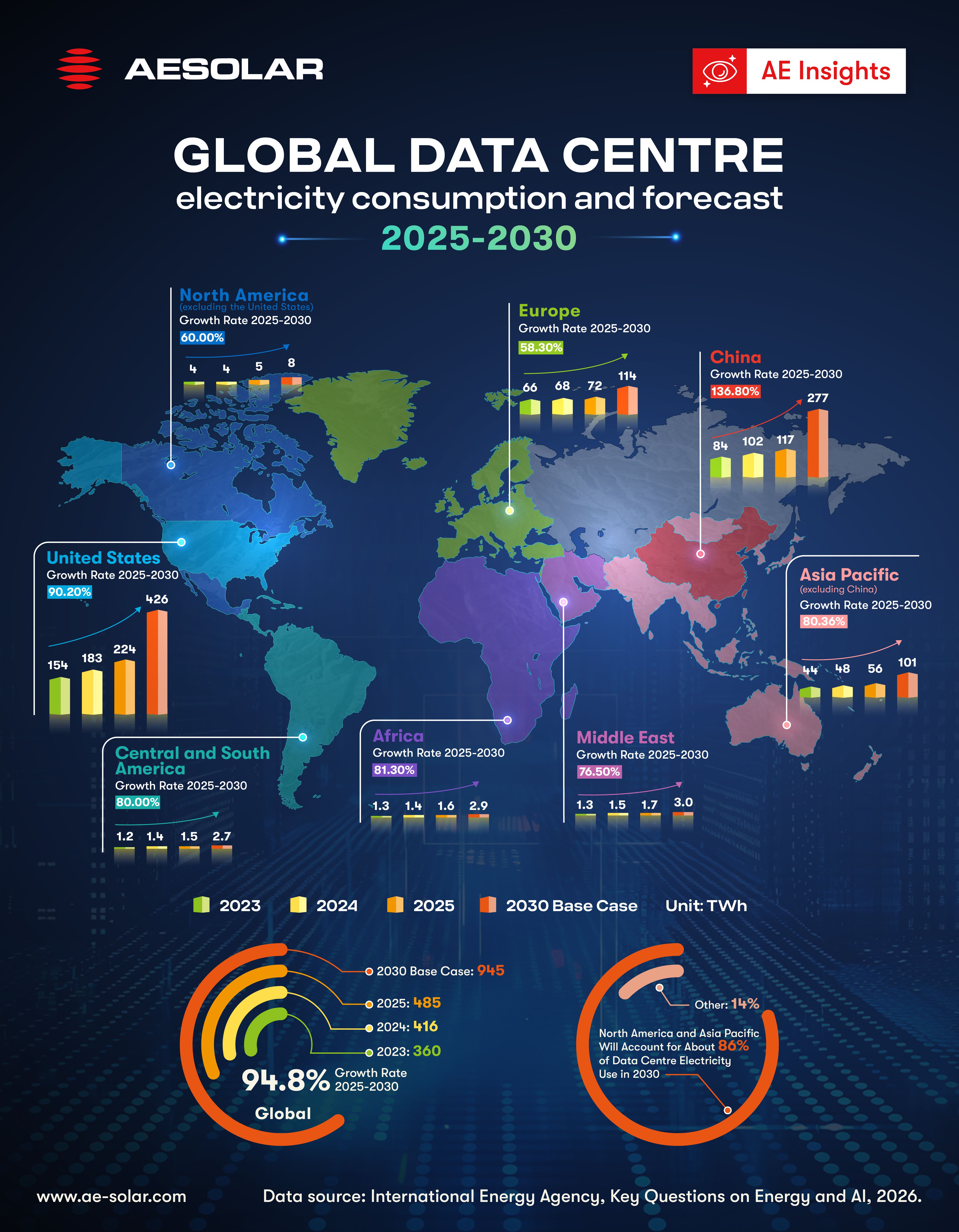
That physical reality is becoming a major energy story. According to the International Energy Agency’s Key Questions on Energy and AI, global data centre electricity consumption is expected to rise from 485 TWh in 2025 to 945 TWh in 2030 under its Base Case. That represents growth of 94.8% in only five years.
The question is how quickly energy infrastructure can respond with cleaner, more flexible electricity.
From 360 TWh to 945 TWh
The speed of change is striking. Global data centre electricity consumption increased from 360 TWh in 2023 to 416 TWh in 2024 and an estimated 485 TWh in 2025. By 2030, the IEA Base Case places demand at 945 TWh.
The regional picture is highly concentrated. The United States is projected to increase from 224 TWh in 2025 to 426 TWh in 2030, while China rises from 117 TWh to 277 TWh. Asia Pacific excluding China grows from 56 TWh to 101 TWh. Together, North America and Asia Pacific are expected to account for about 86% of global data centre electricity use in 2030, based on the IEA regional data.
Capital is following electricity demand
The scale of investment supports the demand outlook. The IEA reports that capital expenditure by five technology companies exceeded USD 400 billion in 2025 and is expected to increase 75% to USD 715 billion in 2026. The group comprises Alphabet, Meta, Microsoft, Amazon Web Services and Oracle, and the report describes the spending as being largely directed towards data centres (IEA).
Google provides a view of what this build-out means operationally. Its data centre electricity consumption increased 27% year over year in 2024, driven partly by AI adoption, even as data centre energy emissions fell 12% (Google Sustainability). In 2025, Google also signed agreements for more than 12 GW of net-new clean energy, its largest annual procurement to date (Google 2026 Environmental Report).
The investment wave extends well beyond the United States. TrendForce forecasts that combined 2026 capital expenditure by Google, AWS, Meta, Microsoft, Oracle, ByteDance, Tencent, Alibaba and Baidu will reach approximately USD 830 billion, up 79% year over year. It identifies Alibaba and ByteDance as important expansion drivers, with Alibaba Cloud reaching 29 regions and 94 availability zones and ByteDance operating across eight countries (TrendForce).
The IEA and TrendForce totals use different company groups, so they should not be compared directly. Together, however, they show that both US and Chinese cloud platforms are committing capital at a scale that will translate into real demand for electricity, grid connections and cleaner generation.
Europe’s 58% growth still matters
Europe’s growth rate is lower than that of the United States or China, but it is far from small. European data centre electricity use is projected to rise from 72 TWh in 2025 to 114 TWh in 2030, an increase of 58.3% in the IEA Base Case.
That additional 42 TWh matters because Europe is pursuing digital competitiveness, energy security and decarbonisation at the same time. Data centres must compete for grid capacity alongside other electrifying sectors.
AI infrastructure can support faster renewable deployment and smarter energy management, provided that power planning moves alongside digital planning.
Solar can help turn demand growth into cleaner growth
The IEA expects renewables to supply around 360 TWh of electricity to data centres by 2030, more than one-third of the total generation serving them. This would represent an increase of more than 200 TWh between 2025 and 2030.
Europe is already showing strong corporate demand for renewable electricity. The IEA reports that European renewable power purchase agreements dedicated to data centres rose from around 1.5 TWh in 2021 to almost 15 TWh in 2025. That nearly tenfold increase makes renewable procurement part of long-term energy strategy, not simply a sustainability statement.
Solar cannot provide every hour of a data centre’s requirement alone. Its full value emerges alongside storage, efficient power conversion, grid connections and flexible operations.
Building intelligence on cleaner energy
AI data centres require reliability as well as volume. Battery storage can smooth load fluctuations and align electricity use more closely with renewable generation.
The IEA projects that longer-duration onsite battery storage dedicated to data centres could grow from around 5 GW in 2025 to 20-25 GW by 2030. This four- to fivefold expansion shows how rapidly storage is moving from a supporting technology to a core part of digital energy infrastructure.
At AESOLAR, we believe solar should play an active role in that future. Digital infrastructure will need electricity that is increasingly clean, intelligently managed and reliable.
Data source: International Energy Agency, Key Questions on Energy and AI, 2026. All 2030 figures are projections from the IEA Base Case.