
Germany registered 698,230 new battery-electric cars in the first ten months of 2026, up 60.7% year on year, according to ACEA’s October registration report. For drivers with a wallbox, much of the electricity already comes through the home: 51,893 owners of subsidised private wallboxes surveyed by Germany’s National Charging Infrastructure Coordination Centre reported taking an average of 75.6% of their charging energy there. That makes solar carport EV charging a practical solution for family.
A week of solar carport EV charging in Gersthofen
AEInsights modelled a three-bay residential solar carport in Gersthofen, Bavaria. The design uses 24 south-facing AESOLAR Horizon CMD-108BDS modules, each rated at 440 W, on a ventilated roof pitched at 10°. Together they provide 10.56 kWp of installed capacity. That figure describes power under standard test conditions; it does not tell a driver how many kilowatt-hours will be available after sunset.
To estimate that energy, we used the European Commission’s PVGIS long-term model, which puts annual output for this configuration at about 10,908 kWh, equivalent to 209.2 kWh per seven days.
Rather than select a sunny week, we compared all 52 complete Monday-to-Sunday periods in the 2023 hourly series and chose the closest match: 27 February to 5 March, with 210.5 kWh of AC output. Saturday accounted for 41.3 kWh and Sunday just 6.5 kWh in that historical-weather simulation. Please note these are modelled yields, not meter readings from an installed carport.
From the carport roof to the EV battery
The model’s 14% PV system-loss allowance already covers the solar inverter and wiring, so we do not deduct those losses twice (PVGIS user manual). We route all daytime output through stationary storage, assuming 95% efficiency into the battery and 95% back out. At the 11 kW AC wallbox, we assume 92% of the energy reaches the car battery, consistent with the 5–10% wallbox charging losses reported by ADAC. Of the 210.5 kWh generated, about 200.0 kWh enters storage, 190.0 kWh reaches the wallbox and 174.8 kWh reaches the vehicle.
We assume enough spare storage capacity to hold the entire week’s output, this deliberately removes storage capacity as a constraint; it is not a home battery sizing recommendation.One top-up means charging from 20% to 100% of usable battery capacity, not plugging in once.
The difference is battery size, not a verdict on driving efficiency. Three BMW top-ups require about 156.5 kWh; a third BYD top-up would bring its total to 198.0 kWh, beyond the week’s budget. Neither car could return at 20% and reach 100% on solar power alone every night that week. Storage moves generation into the evening; it does not turn a cloudy Sunday into a sunny Saturday.
Carport modules above a parked car
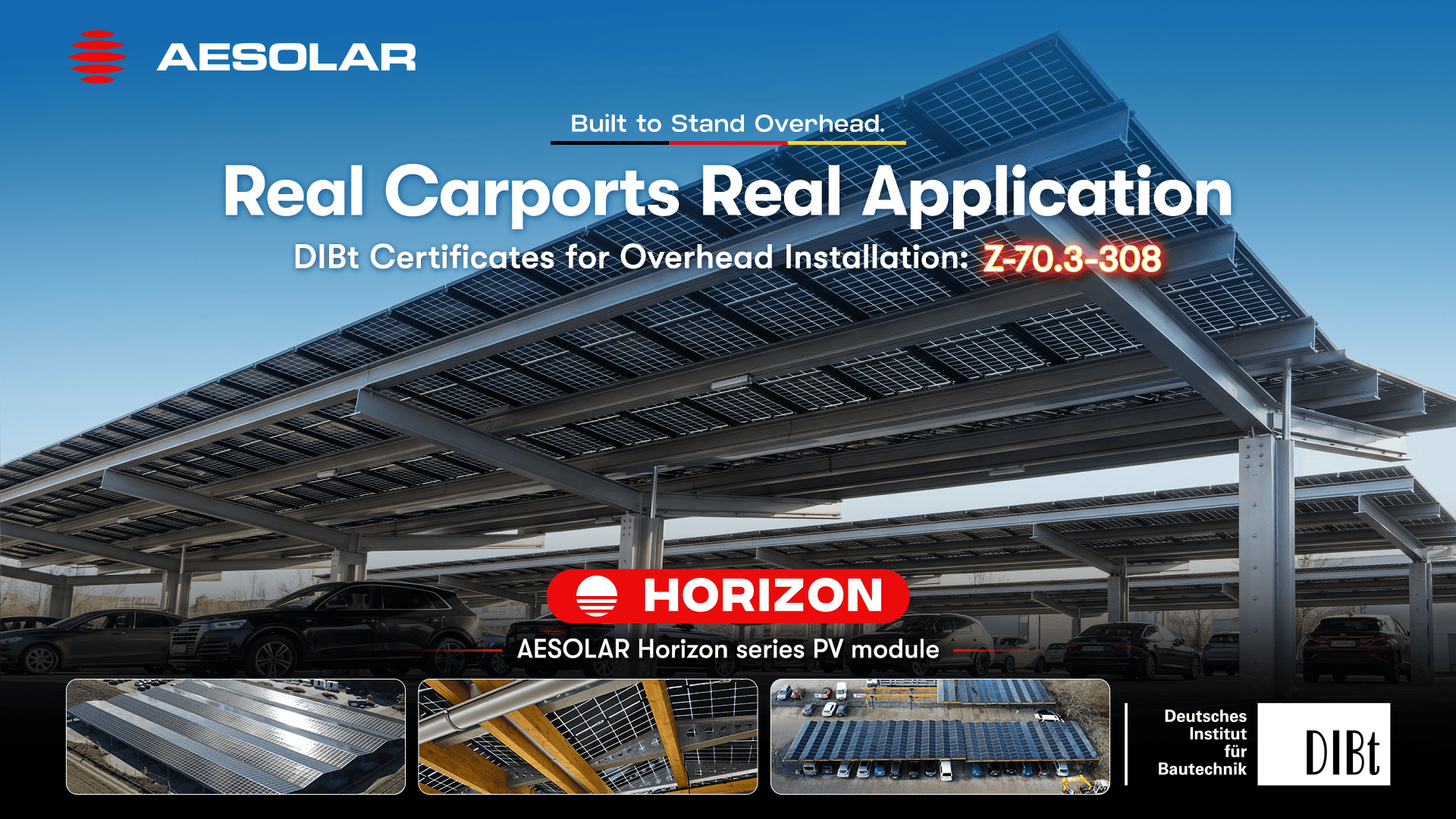
For a carport, the PV module is also part of the roof above people and vehicles. The 440 W Horizon CMD-108BDS is a bifacial, double-glass module; its suitability for overhead use is a separate question from its electrical rating. Germany’s DIBt approval Z-70.3-308 covers the framed CMD-108BDS for use as glazing under specified support and fixing conditions.